Example of Processing DTS data
In a South Texas horizontal tight gas well with multiple frac stages and perforation clusters, the comparison was made between the results from the analysis of multi- arrray PLT and DTS data.
A multiple array tool, consisting of multiple spinner and resistance arrays, was deployed downhole via tractor into this well that had been on production for approximately three months. Multiple up/down passes were made at different speeds in both lateral and vertical sections to assist with spinner calibration. Following this, a retrievable DFO system (with both DTS/DAS) was run in the same wellbore and data was collected continuously for two days.
At a production zone the change in enthalpy is caused by two effects : mixing of fluids produced deeper down the well with fluids produced at the inflow zone and Joule-Thompson heating or cooling effects. An important factor in the cooling equation is the skin pressure drop near the wellbore. The skin pressure drop in its turn depends on the zonal production rate. Plato allows to account for Joule-Thompson cooling by fine-tuning factors that do not depend on the local production rate. DTS data was analyzed for three time slots. The fine tuned JT factors were in agreement for each of the three processings.
The match between these two technologies is reasonably good with only a few uncertainties.
The complete description of the field trial can be read in SPE-170878-MS "Advanced Petrophysical Surveillance Improves the Understanding of Well Behavior in Unconventional Reservoirs".
-
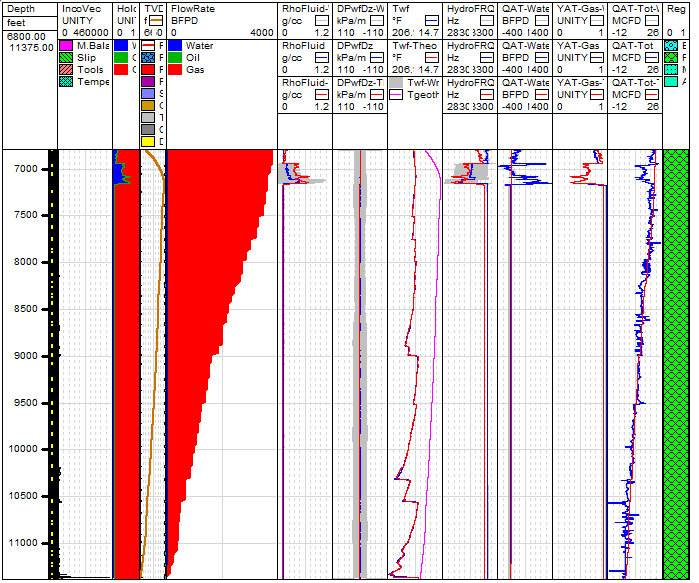 Results of the flowrate optimization for the Array PLT data
 -
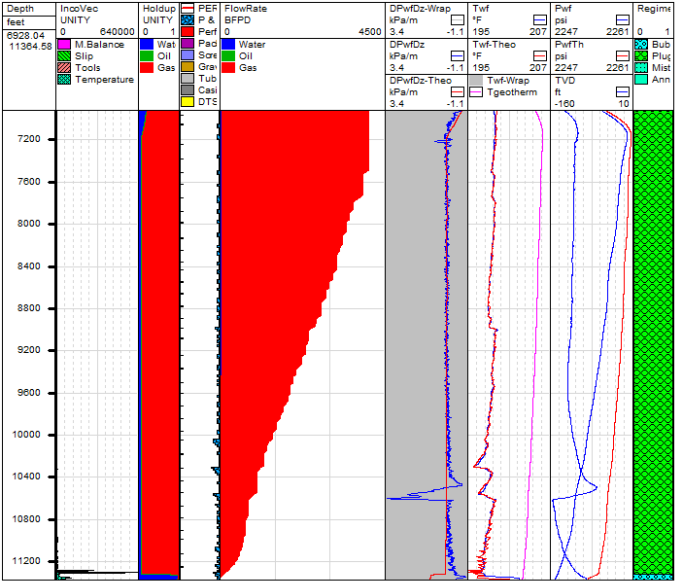 Results of the flowrate optimization for the DTS data