Example of a Simulation
Permanently installed Distributed Temperature Sensing (DTS) was flagged as a potential technology to help overcome the challenges with “conventional” surveillance in the field under study. A feasibility study was used to assess the potential application of DTS for surveillance. Various scenarios were considered based on known reservoir and well behaviours within the field.
Temperature simulations were performed using the characteristics of wells already logged in the field. The purpose of these simulations was to verify whether a DTS installation alone would be sufficient to allow robust determination of the total production from each seperate liner segment or allow the estimation of zonal fluid splits between oil and gas production at each segment.
During the feasibility study, temperature profiles were generated for various production rates and skin pressure scenarios.
This study is thoroughly described in the SPWLA paper: 1401 SPWLA "A Case study of optical sensing applicability in reservoir surveillance - the non unique solution dilemma" prepared for presentation at the SPWLA 55th Annual Logging Symposium held in Abu Dhabi, United Arab Emirates, May 18-22, 2014.
-
 Simulation of the base case using characteristics of Well B
 -
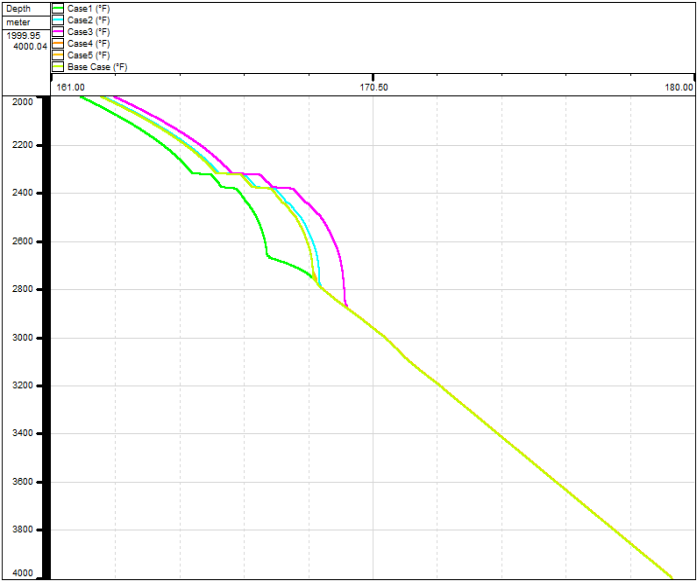 Temperature simulations for various deepest inflow depths
 -
 Temperature simulations for various production profiles
 -
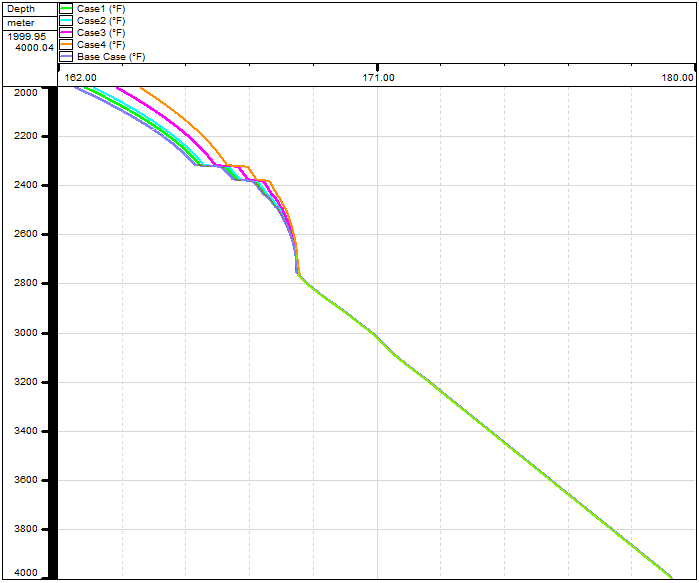 Temperature simulations for various water breakthrough scenarios
 -
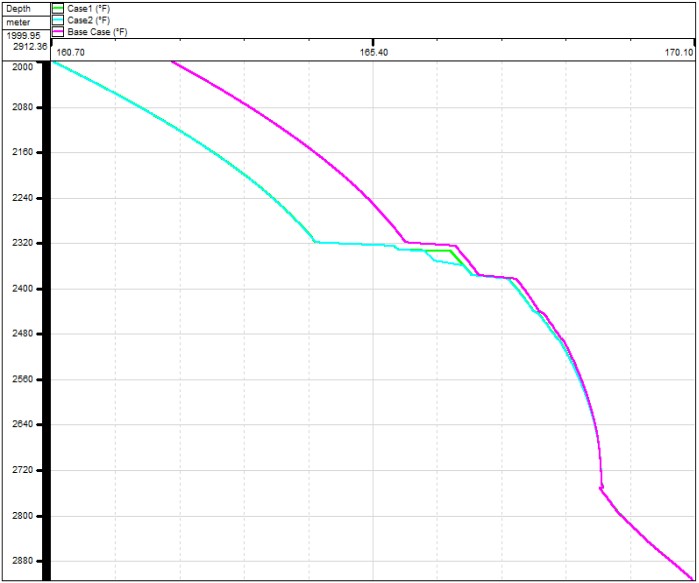 Temperature simulations for various gas breakthrough scenarios
 -
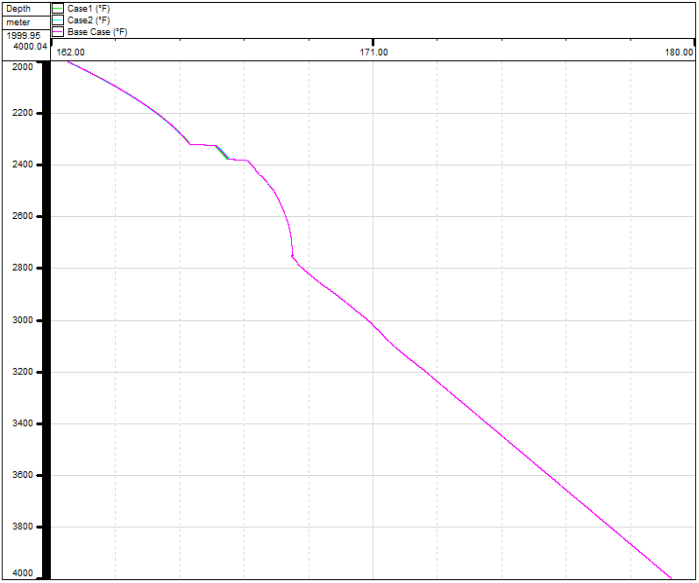 Matching simulated and base temperatures could be obtained for each variation in skin pressure drop by changing the production rates. To ensure more unique answers, the skin pressure must be found from Multi rate analysis or from PLT data.